| The Daily Show With Jon Stewart | Mon - Thurs 11p / 10c | |||
| William Jefferson Airplane | ||||
| ||||
...and I guess I have to catch up on my indie rock clips a bit, so here's one.
| The Daily Show With Jon Stewart | Mon - Thurs 11p / 10c | |||
| William Jefferson Airplane | ||||
| ||||
Visit msnbc.com for Breaking News, World News, and News about the Economy
Visit msnbc.com for Breaking News, World News, and News about the Economy
Visit msnbc.com for Breaking News, World News, and News about the Economy
 As reported in last Sunday's Philadelphia Inquirer, here is how Philadelphia-area members of Congress were recorded on major roll-call votes last week.
Food-safety regulation. Voting 283-142, the House passed a bill expanding the Food and Drug Administration's authority over firms that handle raw and processed foods, including certain farms. The bill (HR 2749) would require hundreds of thousands of domestic and foreign facilities to pay $500 annual registration fees to the FDA, subject them to inspections, and require measures to prevent contamination.Included in the language for this bill is an earmark for the International Food Protection Training Institute, which, as noted here…
A yes vote was to pass the bill.
Voting yes: Robert E. Andrews (D., N.J.), Robert A. Brady (D., Pa.), Michael N. Castle (R., Del.), Charles W. Dent (R., Pa.), Chaka Fattah (D., Pa.), Jim Gerlach (R., Pa.), Tim Holden (D., Pa.), Frank A. LoBiondo (R., N.J.), Patrick Murphy (D., Pa.), Allyson Y. Schwartz (D., Pa.), Joe Sestak (D., Pa.), and Christopher H. Smith (R., N.J.).
Voting no: Joseph R. Pitts (R., Pa.).
Not voting: John Adler (D., N.J.).
…is a non-profit organization established to deliver career-spanning certified food protection training to all State, local, tribal and territorial food protection professionals to assure competency and equivalency in meeting established U.S. federal food safety standards.And let’s not forget that, as noted here…
Charting the phases of the FDA's decline lays bare the responsibility borne by movement conservatism. The first phase was the two terms of the Reagan presidency, when the FDA's staff declined by 30 percent. After a reprieve from 1988 to 1994, when more moderate presidents and a Democratic Congress provided ample boosts in the agency's budget and staffing, the FDA's garroting resumed with a vengeance in the wake of the 1994 Republican landslide that catapulted Gingrich to the House Speaker's chair. He led a highly effective jihad against the agency, pushing to privatize many of its activities. The onslaught continued under George W. Bush and the Republican Congress. From 1994 to 2007, according to (Peter Barton Hutt, who served as FDA chief counsel during the Nixon and Ford administrations), the agency's appropriated personnel declined from 9,167 to 7,856, while its funding increased by only two-thirds of the amount that would have been needed to keep up with inflation.And just to be fair, I should point out that “The Big Dog,” who just flew over to North Korea to ensure the freedom of Euna Lee and Laura Ling, doesn’t get a pass here either (with Dubya thoroughly culpable also, as well as Pancake Joe for another awful vote here).
2010 military appropriations. Voting 400-30, the House approved $636.3 billion in military appropriations for fiscal 2010, including $128.2 billion for war in Iraq and Afghanistan and $29.9 billion for service members' health care. The bill (HR 3326) funds a 3.4 percent military pay raise; bars the military's use of torture and prohibits permanent U.S. bases in Iraq and Afghanistan, while omitting the administration's request for funds to close the U.S. prison at Guantanamo Bay, Cuba.So the next time you hear about more Wall Street financial decadence and possible criminal activity, remember how the “party line” Repugs opposed trying to stop it.
The bill grants the administration's request to cap production of F-22 Raptor fighter jets at 187 planes but funds other large weapons programs targeted by Defense Secretary Robert M. Gates, such as a new VH-71 presidential helicopter fleet, an alternative engine for the F-35 Joint Strike Fighter, and production of more C-17 cargo jets.
A yes vote was to pass the bill.
Voting yes: Adler, Andrews, Brady, Castle, Dent, Fattah, Gerlach, Holden, LoBiondo, Murphy, Pitts, Schwartz, Sestak, and Smith.
Executive compensation. Voting 237-185, the House passed a bill (HR 3269) giving federal regulators power to curb the payment of lucrative executive bonuses by financial institutions. The bill also requires public corporations to give shareholders a nonbinding vote on executive compensation, including "golden parachute" packages, and stipulates that corporate directors who set executive-compensation levels cannot be employed by the company.
A yes vote was to pass the bill.
Voting yes: Adler, Andrews, Brady, Fattah, Holden, Murphy, Schwartz, and Sestak.
Voting no: Castle, Dent, Gerlach, LoBiondo, Pitts, and Smith.
Highway Trust Fund. Voting 363-68, the House passed a bill (HR 3357) shifting $7 billion from general revenues to keep the Highway Trust Fund solvent for the next few months. Supported by the federal gasoline tax, the fund pays for congressionally approved road projects, but it is running low as Americans drive less. The bill also expands Federal Housing Administration lending authority and authorizes federal unemployment funds to borrow from the Treasury to meet U.S. and state obligations to pay jobless benefits.Just let our roads break down, make sure nobody can get an FHA mortgage if they qualify and let anyone collecting an unemployment benefit in PA do without when the money runs out – boy, PA-16’s waste of space truly hit a trifecta here!
A yes vote was to pass the bill.
Voting yes: Adler, Andrews, Brady, Castle, Dent, Fattah, Gerlach, Holden, LoBiondo, Murphy, Schwartz, Sestak, and Smith.
Voting no: Pitts.
"Cash for Clunkers." Voting 316-109, the House sent the Senate a bill (HR 3435) to appropriate an additional $2 billion for the new "Cash for Clunkers" program. Under the program, consumers trade their car or truck for government vouchers worth $3,500 to $4,500 to be applied to the purchase of a new domestic or foreign vehicle having better fuel efficiency. The program exhausted its original $1 billion appropriation in one week.For a program that House Minority Leader John Boehner (R-Man Tan) said that President Obama couldn’t “handle” here, it’s kind of bewildering to me that every one of our local GOP House members except Charlie Dent decided to support it (a comment on Boehner’s “leadership” perhaps?).
A yes vote was to pass the bill.
Voting yes: Adler, Andrews, Brady, Castle, Fattah, Gerlach, Holden, LoBiondo, Murphy, Pitts, Schwartz, Sestak, and Smith.
Voting no: Dent.
SenateJust to let you know, Claire McCaskill of Missouri was the only Dem to vote against the energy bill; she also went through some gyrations here on “Cash for Clunkers,” saying she would approve it if it came from existing stimulus funds.
Highway Trust Fund. Voting 79-17, the Senate sent President Obama a bill (HR 3357, above) that would allocate billions of dollars in Treasury funds to keeping the Highway Trust Fund and federal and state unemployment funds solvent.
A yes vote was to pass the bill.
Voting yes: Thomas Carper (D., Del.), Bob Casey (D., Pa.), Ted Kaufman (D., Del.), Frank Lautenberg (D., N.J.), Robert Menendez (D., N.J.), and Arlen Specter (D., Pa.).
Energy, water appropriations. Voting 85-9, the Senate passed a bill (HR 3183) to appropriate $34.3 billion for energy, water, and nuclear programs in fiscal 2010. In part, the bill would provide $6.5 billion for maintaining the U.S. nuclear stockpile; $5.4 billion for the Army Corps of Engineers; $4.9 billion for the Department of Energy's scientific research; $2.2 billion for developing renewable energy and energy efficiencies; $1.1 billion for the Bureau of Reclamation; and $160 million for the Nuclear Regulatory Commission.
A yes vote was to pass the bill.
Voting yes: Carper, Casey, Kaufman, Lautenberg, and Specter.
Not voting: Menendez.
GM, Chrysler ownership. Voting 38-59, the Senate defeated a plan to require the Treasury to distribute the government's stock in General Motors and Chrysler Corp. to U.S. taxpayers. The amendment to HR 3183 (above) also sought to bar the Treasury from investing any more Troubled Asset Relief Corp. (TARP) funds in the automakers, both of which recently emerged from Chapter 11 bankruptcy reduced in size and under new management.This week, the Senate debated appropriations bills and Judge Sonia Sotomayor's nomination to the Supreme Court. The House is in recess until the week of Sept. 7.
A yes vote backed the amendment.
Voting no: Carper, Casey, Kaufman, Lautenberg, Menendez, and Specter.

I wanted to send you an urgent invitation to an important Town Hall with Sen. Jeanne Shaheen on Thursday morning. She'll be talking to constituents and gathering feedback -- this is an ideal opportunity to make sure your support of health insurance reform is seen and heard at exactly the right time to make a huge difference.Aren’t you just quaking in your shoes at this moment, my fellow prisoners?
Our congressional representatives are back home this month, and they're facing more and more pressure from special interests on health insurance reform. It's critical that we get out there and show them where we stand.
Our representatives are under attack by Washington insiders, insurance companies, and well-financed special interests who don't go a day without spreading lies and stirring up fear. We need to show that we're sick and tired of it, and that we're ready for real change, this year.Pardon me while I splash myself with some cold water – I need to be revived from such a scary verbal onslaught! And the flyer attached to the Email says “Thank you” on one side, and “Standing Together for Health Insurance Reform” on the other. How brazen can you get!
Please come to the Town Hall, and make sure that the most powerful voices in this debate are those calling for real reform, not angrily clamoring for the status quo.
Unlike genuine grassroots activism which tends to be money-poor but people-rich, astroturf campaigns are typically people-poor but cash-rich. Funded heavily by corporate largesse, they use sophisticated computer databases, telephone banks and hired organizers to rope less-informed activists into sending letters to their elected officials or engaging in other actions that create the appearance of grassroots support for their client's cause.And as any Dem will tell you, our party is hardly “rich” (at least on a local level).

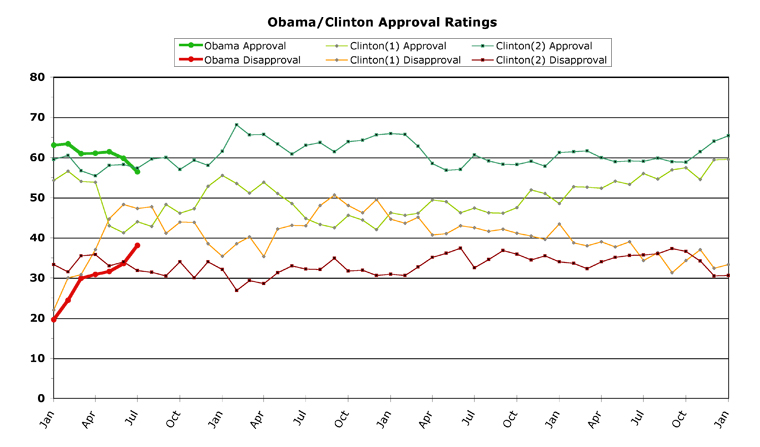
In January, 75 percent of (young people) approved of the job Obama was doing as president. That’s now 58 percent, a 17 percentage point drop (according to the latest Gallup poll).I don’t know if that’s true or not, but I will tell you that all I could find was a link to this Gallup poll dated August 3rd (presumably the latest), and there’s no mention of am age breakdown concerning those polled (and of course, AEI pundit Karlyn Bowman doesn’t provide a link in her post – also, a Quinnipiac poll has Obama at 50 percent, but they don’t bother to tell us how many of those polled were Dems, Repugs or Independent).
Gallup just announced that the President's job approval has slipped to 58%, an all time low for him in Gallup's daily tracking poll. Obama's approval rating has averaged at 63% since he took office, peaking at 69% early in his presidency. He's only dipped below 60% on three other occasions this year. The drop seems to be attributable to respondents identifying as Republican or Independent. Around 92% of Democrats approve of how Obama is doing the job.I believe that Obama’s approval rating at this point is slightly higher than that of Bill Clinton at this point of his first term (noted here more or less, with more independent support for Clinton), just to provide some perspective (and all the Big Dog had to deal with from his predecessor “Poppy” Bush was an economic downtown, significant though it was, as opposed to the near collapse handed to Obama by Poppy’s foul progeny, to say nothing of two wars as well).
Although this latest number is slightly lower than Obama's average, it is still high by historical standards.


…the driving force behind the town hall mobs (trying to stifle the health care debate) is probably the same cultural and racial anxiety that’s behind the “birther” movement, which denies Mr. Obama’s citizenship. Senator Dick Durbin has suggested that the birthers and the health care protesters are one and the same; we don’t know how many of the protesters are birthers, but it wouldn’t be surprising if it’s a substantial fraction.It’s almost ironic beyond words to consider this given that Nixon, in what I believe was his courageous farewell speech (believe it or not), said the following…
And cynical political operators are exploiting that anxiety to further the economic interests of their backers.
Does this sound familiar? It should: it’s a strategy that has played a central role in American politics ever since Richard Nixon realized that he could advance Republican fortunes by appealing to the racial fears of working-class whites.
Always give your best, never get discouraged, never be petty; always remember, others may hate you, but those who hate you don't win unless you hate them, and then you destroy yourself.I wonder how much our discourse would be heightened if the mobs trying to shut down the health care forums and/or scream about Obama’s birth certificate would actually read Nixon’s words instead, realizing that the price paid by our 37th president is one they will all pay in one form or another if they continue on their current path.
Visit msnbc.com for Breaking News, World News, and News about the Economy
Visit msnbc.com for Breaking News, World News, and News about the Economy
 (And I also posted here.)
Corazon Aquino, who died of cancer Saturday at the age of 76, will be remembered as the surprisingly tough “housewife” who forced a dictator, Ferdinand Marcos, to leave office after his attempt to steal an election. But she also deserves to be remembered as the leader of the first “People Power” revolution. Her success strengthened U.S. confidence in what was then a new policy of promoting peaceful democratic change, a policy that remains relevant today.It’s particularly grotesque for someone like Wolfowitz to speak of peace, given that, as Wikipedia noted above, he called for attacking Iraq after 9/11 with the following feeble justification…
...even if evidence does not link Iraq directly to the attack, any strategy aiming at the eradication of terrorism and its sponsors must include a determined effort to remove Saddam Hussein from power in Iraq. Failure to undertake such an effort will constitute an early and perhaps decisive surrender in the war on international terrorism.[4][18]And as quoted in Paul Reynolds' BBC News report, David Rothkopf stated:
Their [The Project for the New American Century's] signal enterprise was the invasion of Iraq and their failure to produce results is clear. Precisely the opposite has happened. The US use of force has been seen as doing wrong and as inflaming a region that has been less than susceptible to democracy. Their plan has fallen on hard times. There were flaws in the conception and horrendously bad execution. The neo-cons have been undone by their own ideas and the incompetence of the Bush administration.[24]Paul Wolfowitz talking about peace has about as much credibility as Kim Jong-Il discussing diplomacy. However, I know this really isn’t news.
President Aquino’s record in office was less distinguished than her record as leader of the opposition. The country today is still a long way from the success that could be expected of a population that is so energetic, hard working and generally well educated.Maybe part of the reason why the Philippines is a “long way” from success is because of the World Bank, which Wolfowitz headed from March 2005 until June 2007, when he had to resign under a cloud of scandal over favors doled out to Shaha Riza, his Arab girlfriend.
The municipality of Magdalena in the province of Laguna was among the first to avail of the World Bank loan under the (Local Government Unit Urban Water Supply and Sanitation Project). In 1998, the World Bank, through the Development Bank of the Philippines (DBP), granted the municipality of Magdalena a P24.22 million loan. When the project was completed in June 2001 the Department of Health (DOH), the Philippine National Standards for Drinking Water (PNSDW) and the Department of Science and Technology (DOST), conducted several water tests. All tests concluded the water from Magdalena’s newly constructed water system is unsafe for drinking.“But you can’t blame Wolfowitz for that,” I hear some cry out there, since the project predated his World Bank presidency.
Despite the proof provided by these tests, the local mayor announced on March 2, 2002 that the water from Magdalena water system was 100 percent potable. The announcement was made without a certificate of water potability. In addition, in the September 2002, the World Bank issued the newsletter In Touch, claiming that “clean, safe water” is now available 24 hours a day for folks in Magdalena.
“International financial institutions like the World Bank can help highly-indebted countries like the Philippines by starting to act like a development institution rather than a commercial bank and by canceling loans it is claiming from us,” continued (Freedom from Debt Coalition) secretary-general Milo) Tanchuling.Perhaps instead of showering accolades on its recently deceased former leader, maybe Wolfie could really do the country a favor instead and petition the organization he used to run for the sake of relieving the Philippine financial burden.
The FDC said if the (World Bank) would indeed start the process of debt cancellation, it can also start with auditing its own loan-financed projects. The group said one loan that should be audited is the loan for the Second Social Expenditure Management Program (SEMP2) and the Small Coconut Farms Development Project (SCFDP).
The SEMP2 was funded by a $100-million World Bank loan, around $40 million of which was earmarked for the procurement of 17.5 million Social Studies textbooks and teachers’ manuals for public elementary and high schools.
“The project allegedly underwent a rigged bidding process involving a monopoly and was reported to have produced at least 600,000 defective textbooks,” said the FDC.
…
The FDC said the Philippines is scheduled to pay a total of $11.46 million or P540 million, both for interest and principal, for the SCFDP loan this year. The loan will be paid until September 15, 2010.
…
With the country’s debt totaling P4.229 trillion as of March this year, and with the deficit soaring 556.2 percent year-on-year from January to May, the economy will be in a more precarious situation should government increase its deficit further, according to the group.
 Yep, it’s time for more “piling on” of our U.S. House Rep over health care courtesy of Bucks County’s official conservative house organ (here, a follow up to this post)…
Maybe Congressman Murphy gets it now: People want to be heard before health care reform is decided. Whether it's to ask questions, make a statement or hear what Murphy thinks, citizens want face time with their congressman.So Patrick Murphy is being baselessly accused here of secrecy on this issue?
That's pretty clear - or should be - after hundreds of worried citizens showed up at two meetings Saturday formulated to handle just a trickle of constituents one on one. The so-called "Congressman on Your Corner" meetings at a Morrisville restaurant and a Levittown supermarket initially were by invitation-only - automated calls to local voters. But a reference to the meetings appeared in this space Thursday in a letter from Murphy Communications Director Kate Hansen. With the meetings out of the bag, so to speak, the expected small gatherings grew large - and boisterous.
Senator Arlen Specter and the health and human services secretary, Kathleen Sebelius, were heckled and booed in Philadelphia on Sunday.And as Think Progress notes here, the two groups noted above organized the “tea parties” that have taken place throughout Obama’s presidency thus far, and likely will continue into the future (with the “teabaggers” providing comic relief, if nothing else – hopefully nothing more sinister or potentially illegal than that).
In Austin on Saturday, a throng of protesters enveloped Representative Lloyd Doggett, Democrat of Texas, at a supermarket where he was trying to meet constituents. They carried signs that said “No Socialized Health Care” and chanted “Just say no!”
And in Morrisville, Pa., Representative Patrick J. Murphy, a Democrat, expected 25 people at a “Congressman on Your Corner” event on Saturday. Instead he was met by a boisterous crowd of about 150 and a barrage of questions on health care.
The protests, organized by loose-knit coalition of conservative voters and advocacy groups, were a raucous start to what is expected to be weeks of political and ideological clashes over the health care overhaul President Obama is trying to push through Congress.
The conservative groups, including FreedomWorks and Americans for Prosperity, are harnessing social networking Web sites to organize their supporters in much the same way Mr. Obama did during his election campaign. Democrats said they expected supporters of the health care overhaul to mobilize against Republican events later in the month.
In Texas, Shirley Markley of Austin said she received an e-mail message from a friend about Mr. Doggett’s meeting on health care and immediately wanted to attend. Once a liberal Democrat, Ms. Markley said, she voted for Senator John McCain for president last year and worries that Mr. Obama’s overhaul will lead to socialized medicine.Does this sound like someone who “want(s) to be heard before health care reform is decided,” as the Courier Times editorial tells us?
When she arrived at the store, she said, a large crowd had already surrounded Mr. Doggett. “People were shouting and booing his answers,” she said. “He said, ‘A few angry people won’t change my mind.’ ”
Eventually, Mr. Doggett cut the meeting short and headed for his car. “He jumped in and fled,” Ms. Markley said with a laugh. “It was like he was tarred and feathered and ridden out of town on a rail. It was a beautiful thing.”
Murphy had notes, but they didn't make points clear. He struggled. He reminded me of a rookie reporter who has digested a mountain of information on a big, complicated story, but has gotten lost in the trifles, and has forgotten to explain, beyond platitudes, why it matters.Wow, J.D., for someone who supposedly has read the entire 1,018-page draft of the House bill (linked in the prior post above), you should have been able to answer these questions in your column (oh, silly me, I forgot – as you’ve said in so many words before, since you’re a columnist, you believe you can write anything you want).
The people in the room wanted straight answers to straight questions.
Will seniors be "counseled" into early graves?
How much will national health care cost, and how do we pay for it?
Does the bill keep malpractice lawyers from suing doctors?
Does Murphy support a "public option," that is, government-controlled health insurance?
I attended the health-care town hall at the Constitution Center ("Passions high at health meeting, " Monday) hoping to actually hear intelligent discussion of a complex and serious issue. By chance, I ended up seated in a nest of right-wing fanatics. They ruined the event for everybody there, which I am sure was their intention.Yep.
I managed to hold on to my sense of humor until the 70-plus-year-old lady seated next to me lurched to her feet, face twisted in fury, and screamed at the top of her lungs, "Excommunicate her!" This was no doubt directed at Health and Human Services Secretary Katherine Sebelius, who has been subjected to a campaign by conservatives in her home state of Kansas to have her cast out of her church because of a lack of sufficient vigor in her opposition to abortion.
Excommunicate her?! Wow. These people are straight out of the 13th century. But what was really going through my mind, as my mouth dropped open: What in heaven's name would this woman's grandchildren (or perhaps great-grandchildren) think to see her behave so badly in public? It's hard to see how people with these attitudes could ever play a meaningful role in setting policy.
Keith H. Cox
Philadelphia
Visit msnbc.com for Breaking News, World News, and News about the Economy
 (And I also posted here.)
Despite the legislative stalemate, the Bush administration mounted an extraordinary array of executive orders, rule changes and organizational innovations to push its program. The White House Office of Faith-Based and Community Initiatives spawned satellite offices in all cabinet-level departments, plus several quasi-governmental agencies, to increase the opportunities for religious groups to win a role in providing a range of social services.I’m not sure that question can ever be answered completely, and I’m really not going to try doing that here, but I just want to provide some more details.
(“Taking Stock: The Bush Faith-Based Initiative and What Lies Ahead,” a project of the Nelson A. Rockefeller Institute of Government at the State University of New York) claims that the effort was remarkably successful in overcoming “the ‘culture of resistance’ that had existed in the federal government toward faith-based organizations’ participation in social service contracts.” The effort spilled over to 36 states, most with Democratic governors, and more than 100 cities that eventually created religion-based offices or liaisons to religious communities.
Beyond that change in culture, what did the Bush initiative accomplish? Because financing flowed through so many different programs, “Taking Stock” concludes, “the full extent of public funding for faith-based social services is largely unknown.” The report suggests that administration officials were highly imaginative in attributing expenditures to the initiative, and in any case those expenditures fell far below the sums promised by the president.
Sadly, there is also little resolution of a central question behind the whole effort: Are religious organizations really more effective in providing social services than government or secular agencies? Or, more precisely, when are they better, when not, and why?
There was a telling episode in 1999 when the Department of Agriculture came out with its annual statistics on hunger, showing that once again Texas was near the top. Texas is a perennial leader in hunger because we have 43 counties in South Texas (and some in East Texas) that are like Third World countries. If our border region were a state, it would be first in poverty, first in the percentage of schoolchildren living in poverty, first in the percentage of adults without a high school diploma, 51st in income per capita, and so on.But if Dubya’s faith-based efforts ended up largely going splat (I mean, in terms of doing practical good as opposed to achieving largely political ends), it wasn’t for lack of trying; as noted here, “Holy Joe” Lieberman and Former Senator Man-On-Dog tried to put the matter “Front and center” just in time for the 2002 congressional elections…
When the 1999 hunger stats were announced, Bush (then governor, of course) threw a tantrum. He thought it was some malign Clinton plot to make his state look bad because he was running for president. "I saw the report that children in Texas are going hungry. Where?" he demanded. "No children are going to go hungry in this state. You'd think the governor would have heard if there are pockets of hunger in Texas." You would, wouldn't you? That is the point at which ignorance becomes inexcusable. In five years, Bush had never spent time with people in the colonias, South Texas' shantytowns; he had never been to a session with Valley Interfaith, a consortium of border churches and schools and the best community organization in the state. There is no excuse for a governor to be unaware of this huge reality of Texas.
The issue of funding religious charities appeals to conservatives who have long sought to lower the church-state wall and overturn the U.S. Supreme Court's 1962 ban on prayer in public schools. Social-service agencies that invoke religion as a way of getting inside the minds of troubled individuals are more effective than those that don't, they argue.And if these programs have been successful in that regard, fine. My chief issue with the “faith-based” activities of the prior administration has been the emphasis on proselytizing and activities for political as opposed to spiritual gain (though this often resulted in underfunding agencies of government that, I would argue, were better equipped to do the job to begin with).
But several prominent religious conservatives, including Christian Coalition founder and former president Pat Robertson, opposed the House legislation because they believed it would open federal coffers to non-traditional religions such as the Nation of Islam and the Church of Scientology.
Opposing the measure are most Democrats, who view a high wall of church-state separation as an essential feature of American democracy. But it has won favor within a key Democratic constituency: racial minorities -- particularly African Americans. Many among them see religiously oriented social-service agencies as a positive force in leading troubled individuals away from crime, drugs, alcohol, teen pregnancy and a host of other social ills.
Despite Congress' failure to pass substantive faith-based legislation, the Bush Administration has been steadily advancing the ball. It established the White House Office of Faith-Based and Community Initiatives, and Centers and Taskforces for Faith-based and Community Initiatives in 10 federal agencies and the Corporation for National and Community Service. It has handed out more than $ 3 billion in grants to a passel of faith-based organizations. It has issued executive orders making it easier for religious organizations to compete for grants, has held numerous training sessions to help religious groups get government grants, and the president has regularly taken to the "bully pulpit" to push the initiative forward.As noted here, though, the bill was referred to a House subcommittee that year, but no further action transpired.
Now, Bush and his Congressional allies are attempting to institutionalize his faith-based initiative through broad-ranging legislation.
Because Bush's Faith-Based Initiative was established through Executive Orders, the White House Office could be eliminated should a future administration decide to rescind those orders. To obviate this possibility, on March 2, Representative Mark Green (R-WI), introduced H.R. 1054, The Tools for Community Initiatives Act. Green's bill "would make the White House Office of Faith-Based and Community Initiatives... and ten similar federal agency offices a permanent part of the federal government," according to the Web site of OMB Watch.
The bill would "establish the offices and outlines their responsibilities. It does not include portions of current regulations that address how religious groups handle federal grants. Instead, these issues are included in a non-binding 'Sense of Congress' section, which does not address the issue of hiring on the basis of religion for federally funded jobs."
The provisions of H.R. 1054 would exist "until Congress acted to eliminate them."
 I swear, half the time I just happen to find this stuff, people; this tells us the following…
Various sources within the Buzz are reporting that Michelle Obama's "organic" garden has been besieged by icky goo in the ground. As a result, the veggies aren't quite what the first lady had in mind. According to Daily Finance, the National Park Service tested the soil in the vegetable patch and found "highly elevated levels of lead" due to sewage used as fertilizer.This Mother Jones story provides more detail…
So the question is: Who to blame? While dumping sewage into the ground sounds like a crime worthy of Mr. Burns from "The Simpsons," the actual perpetrators were none other than the Clintons. Yep, back when Bill and Hillary were living it up in the White House, their gardening team used "sewage sludge for fertilizer." The fiends!
Given that the White House vegetable garden isn't close to buildings that would shed lead-based paint, a combination of sludge and old exhaust particles from lead-based gasoline is more likely to blame for its lead problem. Sludge can legally contain up to 300 parts per million of lead, which is well above the 93 parts per million found in the White House garden. The EPA says that soil with more than 56 parts per million of lead might not provide "adequate protection of terrestrial ecosystems," but doesn't suggest worrying about anything below 400 parts per million as a threat to human health. However, some soil scientists advise against feeding children produce grown on soil with more than 100 ppm of lead. That's cutting it pretty close for Obama's daughters. The Clintons' "very clean poo" might have been too good to be true.And by the way, the story also tells us that the sludge had been used on the White House garden “starting in the late 1980s and continuing for at least a decade” (and I’m sure this will lead to further study, and we’ll just see how that plays out).
UPDATE: The blog Obama Foodorama interviewed lead experts who pointed out that 93 ppm is not an unusual level of lead in urban soils. That level is still well above natural levels and the EPA's own 56 ppm "ecological soil screening level"---hence my reasonable assertion that the garden is "contaminated with lead"--but the contamination could also be the product of old exhaust from lead-based fuel. Of course, it won't be possible to know the background lead level on the South Lawn unless someone sampled it before sludge was applied (a White House spokesman did not return a phone call). Given that lead levels in sludge can legally be way higher than what was found on the Obama garden, I still believe sludge could be a factor in the 93 ppm, but how much of a factor will be hard to say.
Also, on the subject of food, the Obama Administration has issued more stringent food safety rules “to stop salmonella and E.coli contamination in U.S. food processing plants and created a new deputy food commissioner post to coordinate safety,” as noted here.In April 2004, Bush’s USDA issued legally binding guidances allowing the use of antibiotics on organic dairy cows and synthetic pesticides on organic farms. Another 2004 guidance narrowed the scope of the federal organic certification program to crops and livestock, meaning that national organic standards would “not be developed for fish, nutritional supplements, pet food, fertilizers, cosmetics, and personal-care products.” Though then-Agriculture Secretary Ann Veneman reportedly “rescinded the directives” after activist uproar, the vice chairman of the National Organic Standards Board told the Chicago Reader that the USDA “sticks to their interpretations, only now they are no longer posted.” In June 2007, the USDA greenlighted a proposal “allowing 38 new non-organic ingredients in products bearing the ‘USDA Organic’ seal, despite more than 10,000 e-mails and letters from concerned consumers and farmers.” This past September, the USDA “abruptly halted a government program that tests the levels of pesticides in fruits, vegetables and field crops, arguing that the $8 million-a-year program is too expensive.”
Visit msnbc.com for Breaking News, World News, and News about the Economy
Visit msnbc.com for Breaking News, World News, and News about the Economy
As reported in last Sunday's Philadelphia Inquirer, here is how Philadelphia-area members of Congress were recorded on major roll-call votes last week (and I also posted here).HouseThis is a bit off-topic, but I should note that Patrick Murphy will be appearing tomorrow at 1 PM at Concerto Fusion in Morrisville, PA, and at the Acme on New Falls Road in Levittown, PA as part of his “Congressman In Your Corner” events (the 78th and 79th he’s hosted since taking office according to Murphy Communications Director Kate Hansen).
Housing, transportation budgets. Voting 256-168, the House passed an appropriations bill (HR 3288) that provides $68.8 billion in discretionary spending and $123.1 billion in total spending for transportation, housing, and urban development programs in fiscal 2010.
A yes vote was to pass the bill.
Voting yes: John Adler (D., N.J.), Robert E. Andrews (D., N.J.), Robert A. Brady (D., Pa.), Chaka Fattah (D., Pa.), Tim Holden (D., Pa.), Frank A. LoBiondo (R., N.J.), Patrick Murphy (D., Pa.), Allyson Y. Schwartz (D., Pa.), Joe Sestak (D., Pa.), and Christopher H. Smith (R., N.J.).
Voting no: Michael N. Castle (R., Del.), Charles W. Dent (R., Pa.), Jim Gerlach (R., Pa.), and Joseph R. Pitts (R., Pa.).
Public housing. Voting 152-276, the House refused to kill the HOPE VI public-housing program, which provides grants to communities for replacing rundown projects with mixed-income housing and support services for residents. Critics said the program is duplicative and has a multiyear backlog of unspent funds, while defenders argued against reducing the supply of housing for the poor. The amendment to HR 3288 (above) sought to eliminate the program's $250 million budget for 2010.What a shame that Pancake Joe didn’t bother to talk to one of his fellow congressional Repugs on this before he cast yet another ridiculous No vote, because if he had, he would have learned the following (here)…
A yes vote was to kill the program.
Voting yes: Pitts.
Voting no: Adler, Andrews, Brady, Castle, Dent, Fattah, Gerlach, Holden, LoBiondo, Murphy, Schwartz, Sestak, and Smith.
Sen. Christopher S. "Kit" Bond, Missouri Republican, said he would advocate for the new program because it expands on the successful Hope VI initiative he has championed since its creation in 1992.But I guess there must be no such thing as “poverty and distress” in PA-16, then.
He said in an interview that the idea is "to see if we can do something in a coordinated effective effort to end the cycle of poverty and distress … and empower the local residents to have more control over their life."
Mr. Bond cited projects in St. Louis and also on Capitol Hill that are now model communities.
Pay as you go. Voting 265-166, the House passed a bill (HR 2920) putting Congress' pay-as-you-go budget rules into permanent law and giving presidents power to sequester funds when Congress breaks those rules. The bill awaits Senate action.I don’t remember any damn “middle class tax cut” from Dubya – we received about a $400 check not too long after he took over in ’01 I believe, but that was all I saw that made much of an impact.
Under "pay-go," Congress is required to offset tax cuts or increases in mandatory spending beyond baseline levels with matching revenue hikes or spending cuts. The bill exempts politically popular measures such as Alternative Minimum Tax relief, the Bush administration's middle-class and estate-tax cuts, and Medicare payments to doctors.
A yes vote was to pass the bill.
Voting yes: Adler, Andrews, Brady, Castle, Fattah, Holden, Murphy, Schwartz, and Sestak.
Voting no: Dent, Gerlach, LoBiondo, Pitts, and Smith.
Health, education spending. Voting 264-153, the House passed a bill (HR 3293) that provides $160.7 billion in discretionary spending and $567 billion in mandatory spending for health, education, and labor programs in fiscal 2010. The bill ranks second to the Pentagon budget as the largest of the appropriations bills that will fund the $3.6 trillion federal budget next fiscal year.As noted here…
The bill ends a 21-year ban on funding needle-exchange programs to curb the spread of AIDS and other infectious diseases.
A yes vote was to pass the bill.
Voting yes: Adler, Andrews, Brady, Castle, Dent, Fattah, Gerlach, Holden, LoBiondo, Murphy, Schwartz, Sestak, and Smith.
Voting no: Pitts.
NEPs are an inexpensive public health intervention, especially when compared with the social costs of treating individuals with HIV or hepatitis-related chronic liver disease. The costs of preventing one case of HIV is estimated between $4,000 and $12,000 via NEPs. The medical cost of treating a person infected with HIV is about $200,000. Emergency room usage is lower among intravenous drug users if a NEP is in place. HCV-related liver disease, including cirrhosis and liver cancer, are estimated to cause more fatalities in 2010 than AIDS. Infected mothers can transmit the virus to infants before or during birth, or through breast feeding. One-thousand five-hundred intravenous drug users in Baltimore had entered an NEP as of the year 2000. The rate of HIV infection in Baltimore decreased by 70 percent between 1992 and 2000. The single use of sterile syringes is one of the most effective methods to limit the transmission of HIV and Hepatitis B and C and reduce disease transmission among drug users, their sexual partners and their children.This is a welcome development for many reasons, one of which is that the Obama Administration disappointed needle-exchange advocates here by proposing to continue the funding ban that was instituted in 1989 as a rider to the Health and Human Services appropriations budget and renewed every year since. I have a feeling, though, that he believed the ban should have been removed through congressional legislation instead of through a presidential directive, given that he has spoken favorably in the past of needle exchange programs.
…
NEPs are more than a needle exchange program. Studies have shown that NEPs save lives, reduce suffering and lower the economic cost to society due to intravenous use of illegal drugs. If NEPs are associated with other services such as substance abuse treatment, then it is more likely that the ferocious cycle of drug abuse can be broken.
SenateThis is a pathetic, insulting vote by Bob Casey, which goes hand-in-hand with his “co-op” copout on a public health care plan. As I’ve said before, he has become every bit the “corpocrat” I feared he would be after he defeated Chuck Pennacchio for the Democratic Party Senatorial nomination in 2006.
2010 military budget. Voting 87-7, the Senate authorized a $680 billion military budget for fiscal 2010, including $130 billion for war in Iraq and Afghanistan. The bill (S 1390) sets a 3.4 percent military pay raise, increases active-duty personnel by 40,200 troops to 1.41 million, and caps procurement of F-22 Raptor fighter jets at 187 planes.
A yes vote was to pass the bill.
Voting yes: Thomas Carper (D., Del.), Bob Casey (D., Pa.), Ted Kaufman (D., Del.), Frank Lautenberg (D., N.J.), Robert Menendez (D., N.J.), and Arlen Specter (D., Pa.).
Concealed handguns. Voting 58-39, the Senate failed to reach 60 votes for advancing a measure setting federal rules for concealed handguns. The amendment to S 1390 (above) sought to require the 48 states (all but Wisconsin and Illinois) that issue concealed-handgun permits to honor the permits of other states, even ones based on less-strict qualifications. The amendment was backed by the National Rifle Association and opposed by Handgun Control Inc.
A yes vote was to advance the amendment.
Voting yes: Casey.
Voting no: Carper, Kaufman, Lautenberg, Menendez, and Specter.
 (And I also posted here; I'm sure it will generate more wingnut umbrage, but oh well.)
Could it be the government would limit medical treatment for the old and sick as a means to control health care costs?Actually, the AAPS is a lot more than that; as noted here, the…
Seems that way to me, after reading the thousand-page health care bill under review by the U.S. House of Representatives.
Seems that way to the American Association of Physicians and Surgeons, too, an organization formed in 1943 to oppose government-run health care.
…AAPS is generally recognized as politically conservative,[4][5][6] though it describes itself as "non-partisan".[7] The organization opposes mandatory vaccination,[8] universal health care[9] and government intervention in healthcare.[10] The AAPS has characterized the effects of the Social Security Act of 1965, which established Medicare and Medicaid, as "evil" and "immoral",[11] and encouraged member physicians to refuse to accept or participate in Medicare and Medicaid.[12][13]Somehow I don’t think “conservative” and “oppos(ing) government-run health care” really describe how reactionary and backward this group truly is.
An agitated octogenarian (upset over Mullane’s baseless accusation that the health care legislation ultimately would withhold treatment to contain costs) called Monday to say I'm "spouting nonsense."I’ll get back to that a bit later, but continuing with Mullane for now…
"How would you know what they mean? Are you an expert on the thing?" he asked.
Not an "expert," I assured, but I did pay particular attention to section 1233 of the bill, which I call the "Angel of Death" clause.
The octogenarian, however, admitted he hadn't read the bill, but said he doesn't have to because he reads The New York Times, among other fine newspapers, to get his information.In his typically insipid way, Mullane is extolling the supposed virtues of health care retirement accounts, sponsored by Dubya of course; this tells us the following, just to refresh our memories…
For the octogenarian, Medicare (which he reminded me at least three times is "socialized medicine") works fine for him. He insisted it will work for the rest of the country.
We veered on a tangent, and I asked why should I - as the father of three little kids and with lots of bills to pay - have to pay for his medical care? During his working years, I asked, why didn't he anticipate what he would need in retirement and set it aside?
"You just can't work. You have to live," he said.
So do I. But I digress.
So what of Mullane today (here)? Well, in the guise of addressing reader comments, he pretty much rehashes much of Tuesday’s column and, for good measure, tells us that the House health care bill (with Obama’s blessing, as J.D. sees it) is just another step closer to the type of health care practiced in Oregon (with a particularly astute commenter noting that the state’s “Right To Die With Dignity Act” was approved by a popular referendum.)The idea behind health savings accounts is that Americans have too much insurance. You read that right. Those who came up with the idea believe Americans are overinsured, something that very few working families would likely agree with. Despite the rhetoric, HSAs will do nothing to control skyrocketing health care costs or reduce the number of uninsured. In fact, they will just make matters worse for those who have health coverage. By shifting the costs to workers, HSAs provide cover to employers to reduce or even eliminate health benefits. It will undermine employer-based health plans, where two-thirds of Americans get their coverage. HSAs will drive the wealthy and healthy away from health care insurance, driving up the costs for those who need insurance the most. Seniors and those who need health care coverage will see their premiums skyrocket. HSAs are brought to you by the same people who brought you the Medicare prescription drug disaster, and it will have the same consequences. It's a boon to the profit-driven drug companies and insurance industry. It's complicated, fragmented and costly.
I know people are "pulling the plug" daily in hospitals all over the country for one medical reason or other. I myself, as a sufferer of Severe Emphysema, will face this situation as I will eventually end up in a hospital on a ventilator. My family already knows not to sustain my life that way as I have already expressed my wishes, something I fear many people, ill or not, don't do but probably should. I read the section you refer to as an attempt to get information from physicians to patients regarding end of life situations, perhaps a living will in the event they find themselves in a situation similar to mine.As noted above, Mullane claims that he has read the entire bill, which totals 1,018 pages. Though I doubt it, I have no evidence to indicate that Mullane is lying, so I must take him at his word (though of course he cannot prove conclusively that the plan seeks to prevent the elderly from receiving treatment for cost reasons – and as we know, that would never happen in our wonderful, private, for-profit health care system, as noted above).
I read that section twice and haven't found why you refer to it as the "Angel of Death clause.", can you enlighten me?
You also take to task the octogenarian by writing; "..I asked why should I---as the father of three little kids with lots of bills to pay---have to pay for his medical care?"
I ask you; who pays for those who don't have insurance, using, instead of a primary care physician for the flu at the cost of perhaps $140.00, go to emergency rooms as the untreated flu develops into pneumonia requiring an 8 day hospitalization at a cost of perhaps $15,000? You're already paying for people without insurance through higher insurance premiums and deductibles for you and your employer. Remember the infamous $15.00 aspirin a hospital patient received?
For our ruling on this one, there's really no gray area here. McCaughey incorrectly states that the bill would require Medicare patients to have these counseling sessions and she is suggesting that the government is somehow trying to interfere with a very personal decision. And her claim that the sessions would "tell [seniors] how to end their life sooner" is an outright distortion. Rather, the sessions are an option for elderly patients who want to learn more about living wills, health care proxies and other forms of end-of-life planning. McCaughey isn't just wrong, she's spreading a ridiculous falsehood.(And by the way, here is a Balloon Juice post exploding other conservative lies on this subject, such as Medicare and Medicaid’s costs supposedly outpacing those of private insurance – they’re not – and Obama’s supposed pursuit of a British-modeled, “single-payer” system – unfortunately, this isn’t true either.)